

The Narendra Modi Stadium in Ahmedabad is the largest cricket stadium in the world by seating capacity, with room for 132,000 spectators. It sits well ahead of the Melbourne Cricket Ground, which has a listed capacity of 100,024. Large cricket venues are concentrated in India and Australia, although Singapore also appears among the highest-capacity grounds. The ranking below is based on the capacity list published in July 2024, so it measures seats rather than boundary size, field area or match attendance.
Top 10 cricket stadiums by listed capacity
| Rank | Stadium | City | Country | Listed capacity |
| 1 | Narendra Modi Stadium | Ahmedabad | India | 132,000 |
| 2 | Melbourne Cricket Ground | Melbourne | Australia | 100,024 |
| 3 | Eden Gardens | Kolkata | India | 68,000 |
| 4 | Shaheed Veer Narayan Singh International Cricket Stadium | Naya Raipur | India | 65,000 |
| 5 | Perth Stadium | Perth | Australia | 61,266 |
| 6 | Adelaide Oval | Adelaide | Australia | 53,500 |
| 7 | Singapore National Stadium | Kallang | Singapore | 52,000 |
| 8 | Bharat Ratna Shri Atal Bihari Vajpayee Ekana Cricket Stadium | Lucknow | India | 50,100 |
| 9 | The Sports Hub Trivandrum | Thiruvananthapuram | India | 50,000 |
| 10 | JSCA International Cricket Stadium | Ranchi | India | 50,000 |
The final places are especially close. The July 2024 capacity list also records Brabourne Stadium in Mumbai and Shrimant Madhavrao Scindia Cricket Stadium in Gwalior West at 50,000, meaning several venues share the same capacity band. Capacity figures can also differ between venue listings when redevelopment, seating configurations and event arrangements are considered.
1. Narendra Modi Stadium, Ahmedabad
Narendra Modi Stadium is the clear leader in this ranking. The BCCI lists its capacity at 1,32,000 and describes it as the largest sports stadium in the world. The Ahmedabad venue was renovated in 2021 and is associated with the Gujarat Cricket Association. Its listed ends are the Adani Pavilion End and Jio End, and it has floodlights.
The stadium’s scale gives major international matches and finals a distinctive sense of occasion. The BCCI notes that Sunil Gavaskar became the first batter to pass 10,000 Test runs at the venue in March 1987. It also records that the ground has hosted IPL finals. For readers comparing large-event settings, cricketmatchprediction.com can sit alongside venue information as one way to follow the wider match conversation.
2. Melbourne Cricket Ground, Melbourne
The Melbourne Cricket Ground, commonly called the MCG, is listed with a capacity of 100,024, making it the only other cricket ground in the 100,000-plus category. It is home to Australia, the Victoria cricket team and Melbourne Stars in the July 2024 capacity listing. The ground is also used for sports beyond cricket, including Australian rules football, soccer, rugby and concerts.
Its annual Boxing Day Test is one of the MCG’s best-known cricket fixtures. The venue’s multi-sport role is worth noting when comparing capacities: a stadium may be a major cricket ground while also having a calendar and seating arrangements shaped by other events. That does not lessen its importance to cricket, but it does explain why capacity alone cannot capture every aspect of a venue’s identity.
3. Eden Gardens, Kolkata
Eden Gardens is listed at 68,000 and remains one of India’s most recognisable cricket venues. Before the Narendra Modi Stadium renovation, it held the title of India’s largest venue at that capacity, according to the BCCI. The Kolkata ground is associated with India, Bengal and Kolkata Knight Riders in the July 2024 capacity list.
The stadium also occupies an important place in World Cup history. The BCCI notes that Eden Gardens was the first ground to host a World Cup final after Lord’s staged the first three, doing so in 1987. Its High Court End and Pavilion End are familiar reference points for players and supporters, while its location beside the Hooghly River contributes to the venue’s distinctive setting.
4. Shaheed Veer Narayan Singh International Cricket Stadium, Naya Raipur
Shaheed Veer Narayan Singh International Cricket Stadium in Naya Raipur has a listed capacity of 65,000. That places it fourth in the July 2024 worldwide list and second among the Indian grounds in this top 10. It is one of several large Indian venues outside the country’s traditional metropolitan cricket centres.
The listing identifies India, Chhattisgarh and Delhi Capitals among the venue’s home teams. While capacity does not reveal how regularly a stadium hosts international cricket, it does show the scale of infrastructure available across Indian domestic cricket. A 65,000-seat stadium provides room for a large audience when high-profile fixtures come to the region.
5. Perth Stadium, Perth
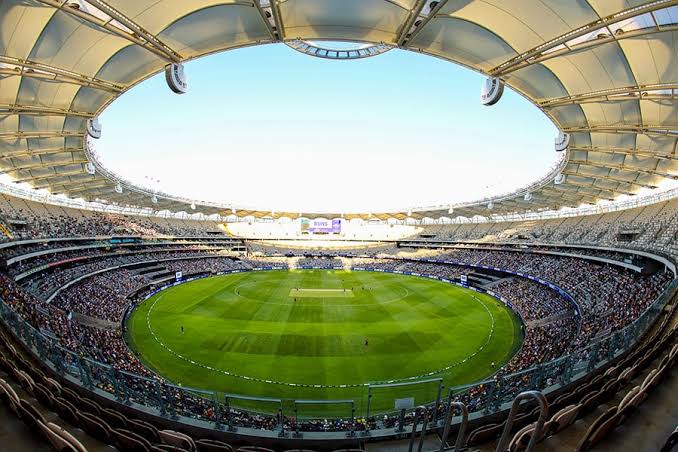
Perth Stadium has a listed capacity of 61,266. The Australian venue is connected with Australia, Western Warriors and Perth Scorchers in the July 2024 list. It is the third Australian stadium in the top 10, following the MCG and preceding Adelaide Oval.
The presence of Perth Stadium in this group illustrates the depth of large cricket facilities in Australia. Its capacity places it ahead of Adelaide Oval by more than 7,000 seats, although both are prominent cricket venues. Comparing these figures is useful for understanding crowd potential, but it should not be confused with a comparison of atmosphere, pitch behaviour or the importance of particular fixtures.
6. Adelaide Oval, Adelaide
Adelaide Oval is listed at 53,500. It is associated with Australia, Southern Redbacks and Adelaide Strikers. Like the MCG and Perth Stadium, it demonstrates that Australia has multiple cricket grounds capable of accommodating more than 50,000 spectators.
At sixth place, Adelaide Oval is just above the 50,000-capacity group that occupies the lower end of this ranking. That narrow difference shows why lists of the world’s biggest stadiums can change after expansions or alterations to seating layouts. The primary point of the table is therefore comparative: it shows the order of the published capacities rather than treating each number as a permanent, universal measure.
7. Singapore National Stadium, Kallang
Singapore National Stadium in Kallang is listed with a capacity of 52,000. It is the only venue outside India and Australia in this top 10, and the list identifies the Singapore national cricket team among its home teams. Its place in the ranking underlines cricket’s presence in multi-use stadiums across Asia.
A stadium’s inclusion in a capacity ranking does not mean it hosts the same volume or type of cricket as a dedicated traditional ground. Singapore National Stadium’s 52,000 seats nevertheless put it ahead of several well-known Indian venues in this specific measure. It is a reminder that capacity rankings answer a narrow question: how many spectators a listed venue can hold.
8-10. India’s 50,000-seat group
Lucknow’s Bharat Ratna Shri Atal Bihari Vajpayee Ekana Cricket Stadium is listed by the BCCI at 50,100, slightly above the 50,000 group. Built in 2017, it has North End and South End as its named ends and is associated with the Uttar Pradesh Cricket Association. The BCCI notes that it staged its first World Cup fixture during the ICC Men’s Cricket World Cup 2023.
The Sports Hub Trivandrum in Thiruvananthapuram and JSCA International Cricket Stadium in Ranchi are both listed at 50,000 in the July 2024 capacity compilation. The BCCI’s venue page calls the Thiruvananthapuram ground Greenfield International Stadium and gives it a 50,000 capacity. These closely grouped venues show that India’s largest cricket infrastructure extends well beyond Ahmedabad and Kolkata.
Capacity is only one way to judge a ground
The biggest cricket stadium is not necessarily the ground with the largest playing area or the largest boundaries. Seating capacity measures how many people can be accommodated, whereas dimensions describe the space in which the match is played. M. Chinnaswamy Stadium, for example, is described by the BCCI as having boundaries of around 65 metres, yet its capacity is 33,800, outside this top-10 list.
Venue rankings also need a date attached to them. Renovations, stand closures and changes in seating layouts can alter published totals. For a historical or practical comparison, the most useful approach is to state the capacity source and period clearly, then avoid treating a list as a measure of a stadium’s complete cricketing significance.
Narendra Modi Stadium led the capacity ranking in July 2024, while the MCG was the only other ground above 100,000 seats. Eden Gardens, Naya Raipur, Perth and Adelaide followed, with India supplying most of the remaining venues in the top 10. These grounds reflect the scale of modern cricket crowds, even though each stadium’s history and match-day character go far beyond its seat count.
